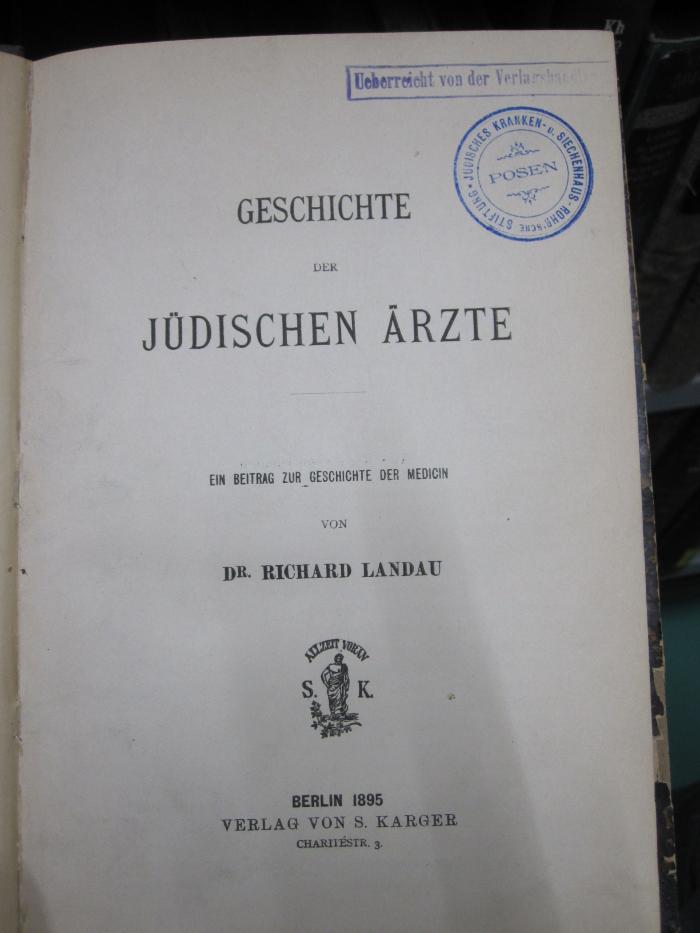


Kh 528: Geschichte der jüdischen Ärzte : Ein Beitrag zur Geschichte der Medicin (1895)
Volume
Identifier/Permalink:
Object 3923Related Persons/Corporations (3)
Abraham und Henriette Rohr'sche Stiftung (belongs to)S. Karger AG (is connected to)
Kulturamt (Lieferant) (supplied by)
Related Marks of provenance (3)
G45 / 148 (Abraham und Henriette Rohr'sche Stiftung), Stempel: Name, Ortsangabe; 'Rohr'sche Stiftung Jüdisches Kranken- und Siechenhaus Posen'. (Prototyp) (mark of provenance is contained in)G45 / 148 (S. Karger AG), Stempel: Besitzwechsel; 'Überreicht von der Verlagshandlung'. (mark of provenance is contained in)
G93 / 1603 (Berliner Stadtbibliothek), Stempel: Name, Wappen, Ortsangabe; 'Berliner Stadtbibliothek'. (mark of provenance is contained in)
Author
Landau, Richard
title
Geschichte der jüdischen Ärzte : Ein Beitrag zur Geschichte der Medicin
Number of Volumes
1
Place of publication
Berlin
Year
1895
Publisher
Karger
Shelf mark
Kh 528
Location
Location;Zentral- und Landesbibliothek Berlin;Verwaltungsstandorte;Rückgabe ZLB
Assessment
Nazi-looted assetsFurther information about this object
The Jewish Hospital for the Sick and Infirm in Poznan was founded by the brothers Moritz (1835-1896) and Isidor Rohr (1839-1904). On June 30, 1887, in memory of their parents, Abraham (1812-1885) and Henriette Rohr (1809-1877, née Tugendreich), they established the Abraham and Henriette Rohr ‘sche Stiftung zur Verbreitung und Förderung des Handwerks, der technischen Gewerbe, der Ackerbau und der Gartenkultur unter den Juden der Gemeinden Jarotschin und Posen’. The foundation was endowed with a share capital of 220,000 marks, of which 200,000 marks were earmarked for the synagogue community in Jarotschin and 20,000 marks for the synagogue community in Posen. The Rohr family was connected to both places, among others Isidor Rohr was born in Jarotschin in 1839. An annual sum of 1,000 marks was to be distributed to the poor, regardless of their religious affiliation, from the interest on the capital earmarked for the synagogue community in Jarotschin.
Moritz Rohr continued his commitment as a philanthropist and donated 600,000 marks for the construction of a Jewish hospital and infirmary in Poznań in 1893. On May 31, 1893, the synagogue community in Posen celebrated the laying of the foundation stone. The site was located on the so-called Posen Kaisergelände in a “park-like setting, in the immediate vicinity of the city - in front of the Königsthor”. Construction was due to be completed in October 1894. The renowned Berlin architect and building councillor, Johann Heino Schmieden (1835-1913), had designed the building project. August Lauber von Spielberg, then government architect in Posen, took over the construction management. Moritz Rohr arranged for the hospital to be donated to the synagogue community in Posen. The hospital opened on June 18, 1895 and Julius Salz (1852-1909), a councillor of justice from Posen, took over the management. A synagogue was set up right next to the hospital building.
In the years from 1930 to 1931, there were plans to close the hospital for cost reasons. However, this was averted thanks to subsidies from the synagogue community. The hospital was able to continue operating until the outbreak of the Second World War in 1939. On September 10, 1939, the German Wehrmacht occupied the city, which now functioned as the capital of the “Reichsgau Wartheland”. In November 1939, Gauleiter Karl Heinrich Wilhelm Koppe (1886-1975) announced that Posen and its surroundings were to be “free of Jews” within three months. The first deportations of Jews still living in the city began in November 1939.
As the hospital building was located directly on the imperial grounds, which the Nazi authorities wanted to transform into a Nazi-compliant administrative district, the Jewish hospital had to close in 1939. The National Socialists rejected its subsequent use by the Nazi authorities, who wanted to build a hospital for the local military and police units, for ideological reasons. The planned construction of a new hospital and the restructuring of the district were not realized until the end of the war. The building of the Jewish hospital was destroyed during the last hostilities in and around Posen in 1945. Only the building of the infection ward survived the war and was converted into a residential building after the end of the war.
Sources:
Moritz Rohr continued his commitment as a philanthropist and donated 600,000 marks for the construction of a Jewish hospital and infirmary in Poznań in 1893. On May 31, 1893, the synagogue community in Posen celebrated the laying of the foundation stone. The site was located on the so-called Posen Kaisergelände in a “park-like setting, in the immediate vicinity of the city - in front of the Königsthor”. Construction was due to be completed in October 1894. The renowned Berlin architect and building councillor, Johann Heino Schmieden (1835-1913), had designed the building project. August Lauber von Spielberg, then government architect in Posen, took over the construction management. Moritz Rohr arranged for the hospital to be donated to the synagogue community in Posen. The hospital opened on June 18, 1895 and Julius Salz (1852-1909), a councillor of justice from Posen, took over the management. A synagogue was set up right next to the hospital building.
In the years from 1930 to 1931, there were plans to close the hospital for cost reasons. However, this was averted thanks to subsidies from the synagogue community. The hospital was able to continue operating until the outbreak of the Second World War in 1939. On September 10, 1939, the German Wehrmacht occupied the city, which now functioned as the capital of the “Reichsgau Wartheland”. In November 1939, Gauleiter Karl Heinrich Wilhelm Koppe (1886-1975) announced that Posen and its surroundings were to be “free of Jews” within three months. The first deportations of Jews still living in the city began in November 1939.
As the hospital building was located directly on the imperial grounds, which the Nazi authorities wanted to transform into a Nazi-compliant administrative district, the Jewish hospital had to close in 1939. The National Socialists rejected its subsequent use by the Nazi authorities, who wanted to build a hospital for the local military and police units, for ideological reasons. The planned construction of a new hospital and the restructuring of the district were not realized until the end of the war. The building of the Jewish hospital was destroyed during the last hostilities in and around Posen in 1945. Only the building of the infection ward survived the war and was converted into a residential building after the end of the war.
Sources:
- Allgemeine Zeitung des Judentums. Ein unparteiisches Organ für alles jüdische Interesse, 16. Jahrgang Nr. 5 (2. Februar 1912, Berlin: Rudolf Mosse, S. 60.
- Bielawska-Pałczyńska, Joanna: Poznań. Spis zabytków architektury. Poznań: Miejskie Posnania, 2004.
- Der Gemeindebote. Beilage zur „Allgemeinen Zeitung des Judenthums“, 57. Jahrgang Nr. 24 (16. Juni 1893), Berlin, S. 1.
- Der Israelit. Ein Central-Organ für das orthodoxe Judenthum, 34. Jahrgang Nr. 46 (8. Juni 1893), Mainz, S. 868.
- Guttstadt, Albert: Krankenhaus-Lexikon für das Deutsche Reich. Berlin: Georg Reimer, 1909.
- Heppner, Aaron / Herzberg, Isaak: Aus Vergangenheit und Gegenwart der Juden und der jüdischen Gemeinde in Posener Landen. Koschmin, Bromberg: Selbstverlag, 1909.
- Oesterreichische Wochenschrift. Centralorgan für die gesamten Interessen des Judenthums, 10. Jahrgang Nr. 1 (6. Januar 1893), Wien, S. 12.
- Szpital Żydowski i Przytułek dla Zniedołężniałych fundacji Abrahama i Henrietty Rohrów w Poznaniu. [online, abgerufen am 30. Mai 2025]
- Witkowski, Rafał: Żydzi w Poznaniu: krótki przewodnik po historii i zabytkach. Poznan: Wydawnictwo Miejskie Posnania, 2012.